Enrich part 1. Situation awareness
- Role: Design lead
- Skills used: Figma - Adobe suite - HTML - CSS
Inriver had already been in the Product Information Management business for several years and had an existing service. With brands like HM, New balance and Cartier as customers, Inriver was already an estasblished PIM service on the market. Coincidingly with my arrival, Inriver was in the middle of transforming from a on-premise software model to a SaaS model. Customers acceess the service through their browser and the service itself run on the Microsoft Azure cloud platform.
Inriver PIM was built up from a small team of engineers with no designer involved, or design team for that matter — not to mention no UX presence at all. Inriver was in many ways a classic engineering first, not design first type of enterprise tech company. Inriver had realized this as the design debt had been stacking up for years while the numbers of customers had been rising steadily as the awerness of PIM spread in the wild. I am very drawn to tech companies at this stage in development. I think the semi-clean slate of already having an established product but no design process is a great opportunity because of the huge posibilities and with it, an equally great adventure together with the whole company.
What is Enrich for?
Enrich is at the core – and the most important part of the PIM system. The idea is to have all the needed product information in one place, for example a retailer who is working on putting up the companys latest t-shirts on cdon.se won't have to source product information like descriptions or images from different places. like instead of having a picture It is the Central Content Repository of all the information a product needs
A person working with adding information to a product is in ecommerce business lingo generally called an "enricher" hence the name for the software, Enrich.
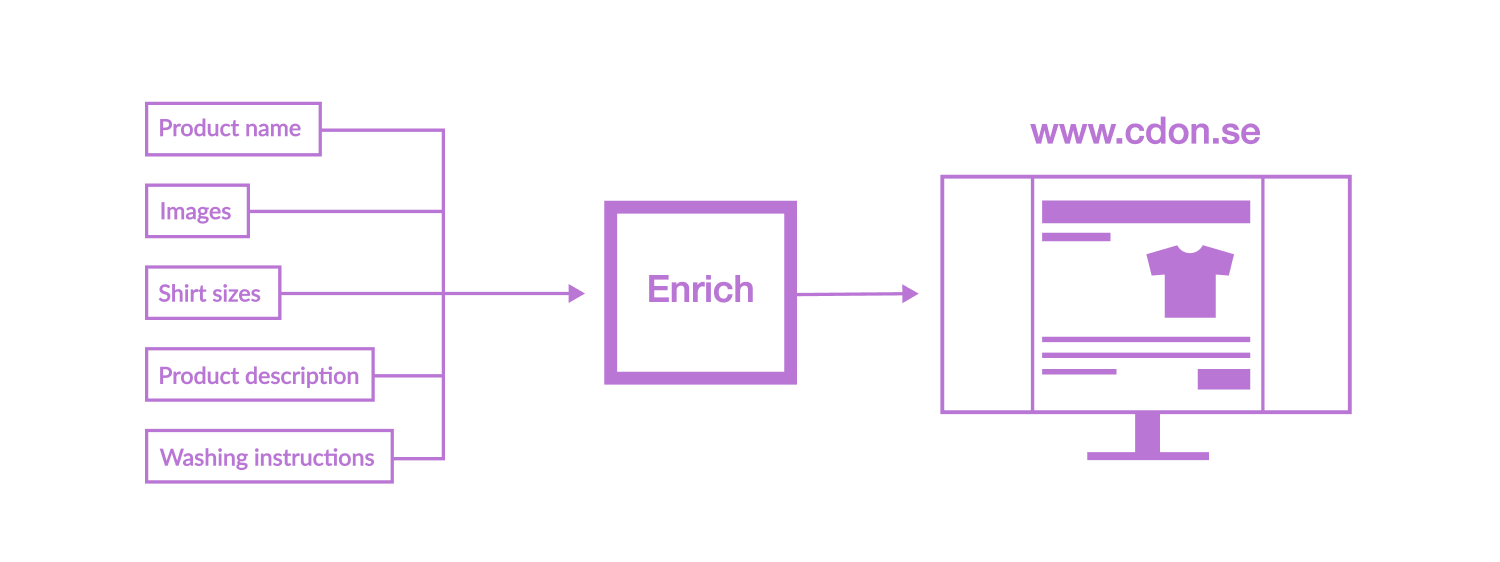
A product you find on a website concist of things like a product title, images etc. These are put into Enrich, and then these content assets are imported to the marketplace.
Embracing the rollercoaster of UX awareness
A big part of why I looked forward to this project was that during a visit at their HQ I realized the very positive attitude and the great people culture. The vibe was great! The foundation almost coulnd't have been better. I was hired by Inriver in 2016 to start building up a design process and figure out a way forward. Eventually we needed to build up a small design team since this would be a way too big task to undetake by myself. Even though the spririts were high, commiting to these types of companies with low UX awareness brings a lot of challenges too.
UX is of course not something you hire and you just have it. You hire a hiking guide to get you there. A company might be aware of the need for better UX, but they don't fully understand the process the company is in for, niether how long it takes to reach a somewhat mature UX state. Converting a engineering driven company is a real challenge in this regard, and boy, Inriver would not dissapoint!
Let's leave the pros and cons for a moment and look at what parts and state Inriver's PIM software where in 2016
The main parts of Enrich
Enrich consists of five main parts which are Overview, Details, Media, Includes and Included in. Let's take a brief look at each one.
Overview
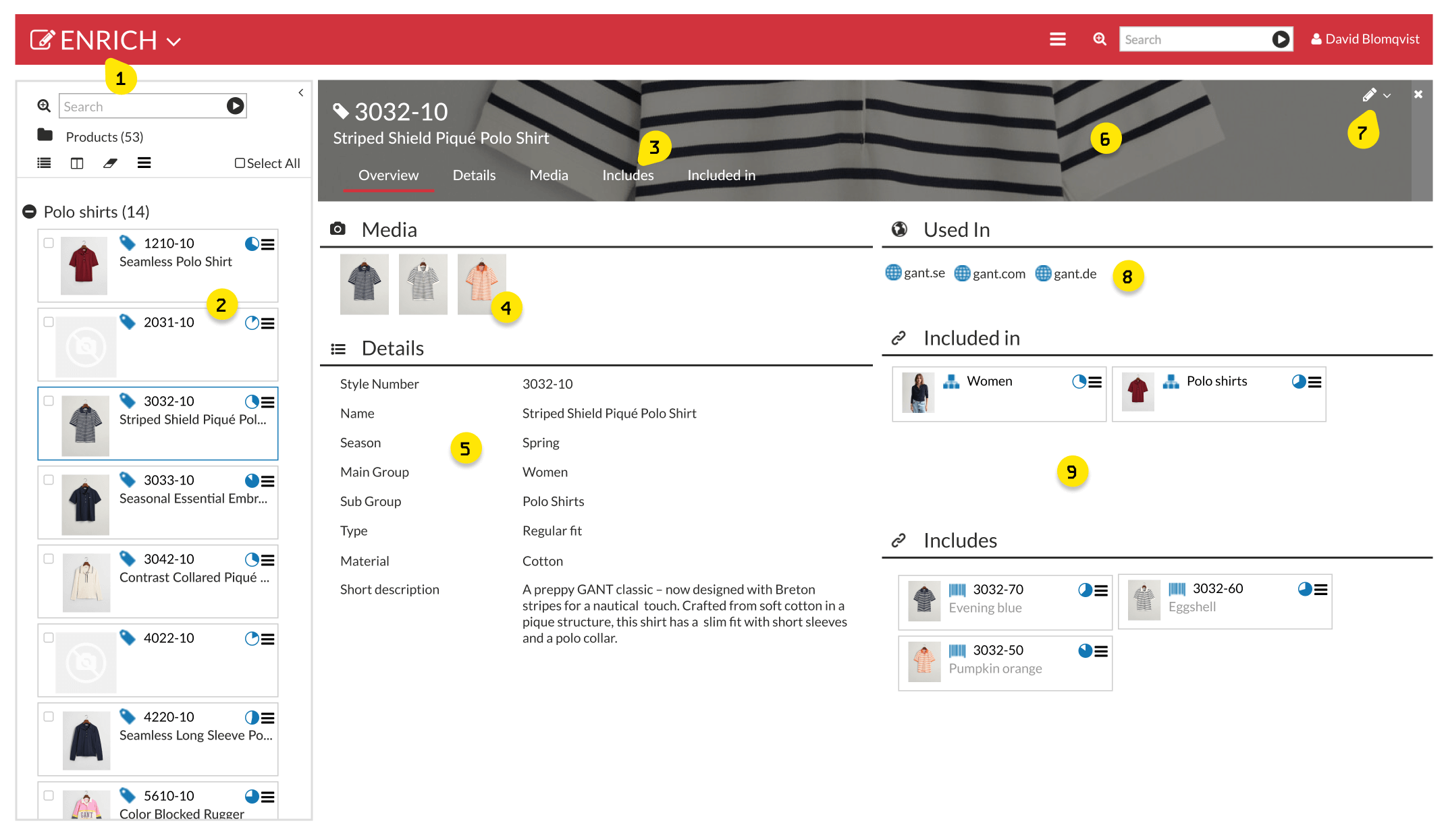
Overview is the landing page a user will first see after having selecting a product. It offers a glimpse of various data in a brief format to give the user an overview of the status of the products data completeness.
- Menu for selecting application
- Products from a folder
- Tab menu for selecting a certain page
- Product images
- Detailed data about the product
- Big product image
- Toolbar
- Marketplaces the product is supposed to go to
- Inludes and Included in is a way to present the products place in the hierachy, whats above and below. Certainly one of the more confusing concepts of Enrich.
Details
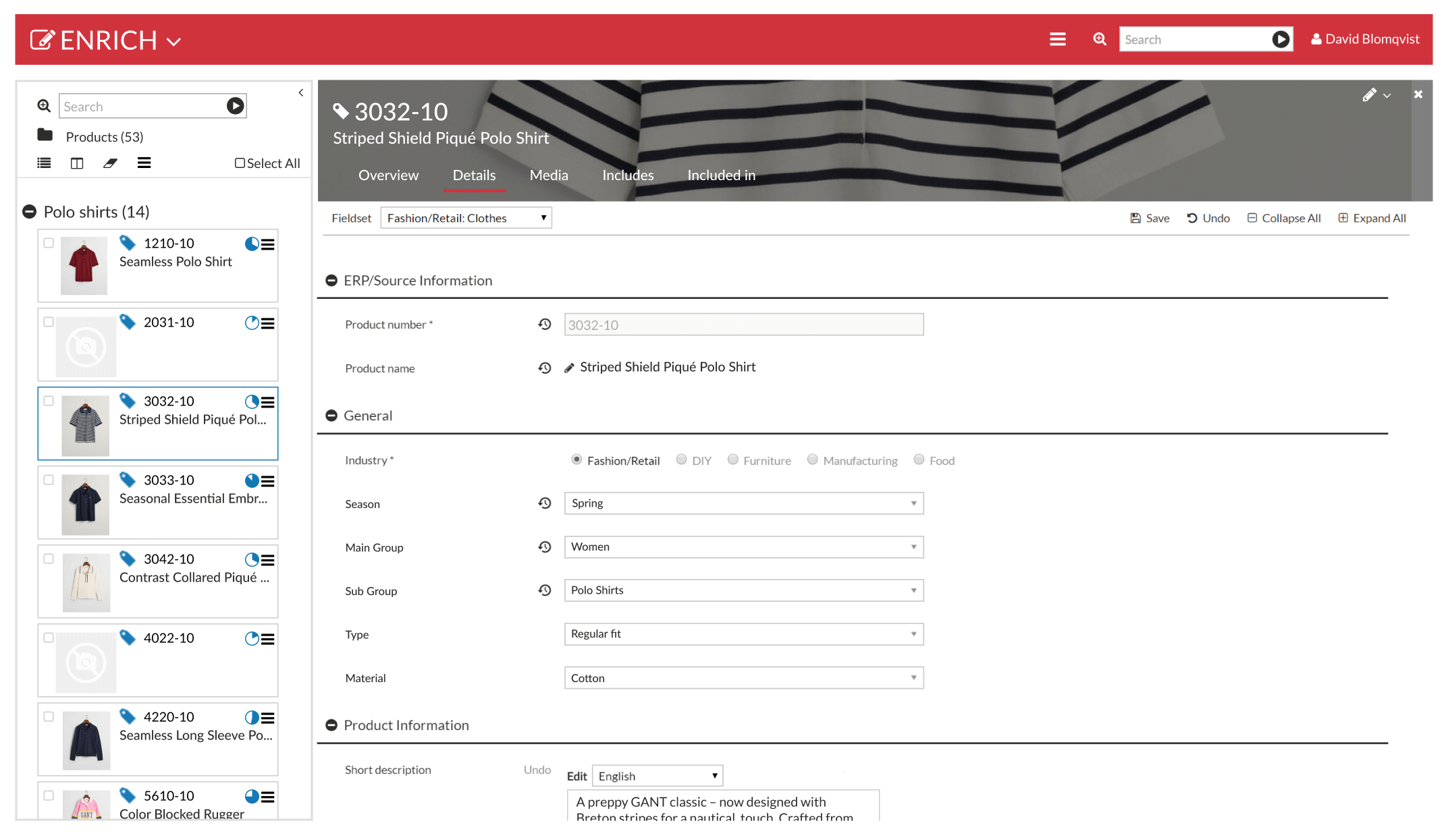
All the details like descriptions, available colours and shirt sizes goes on the Details page.
Media
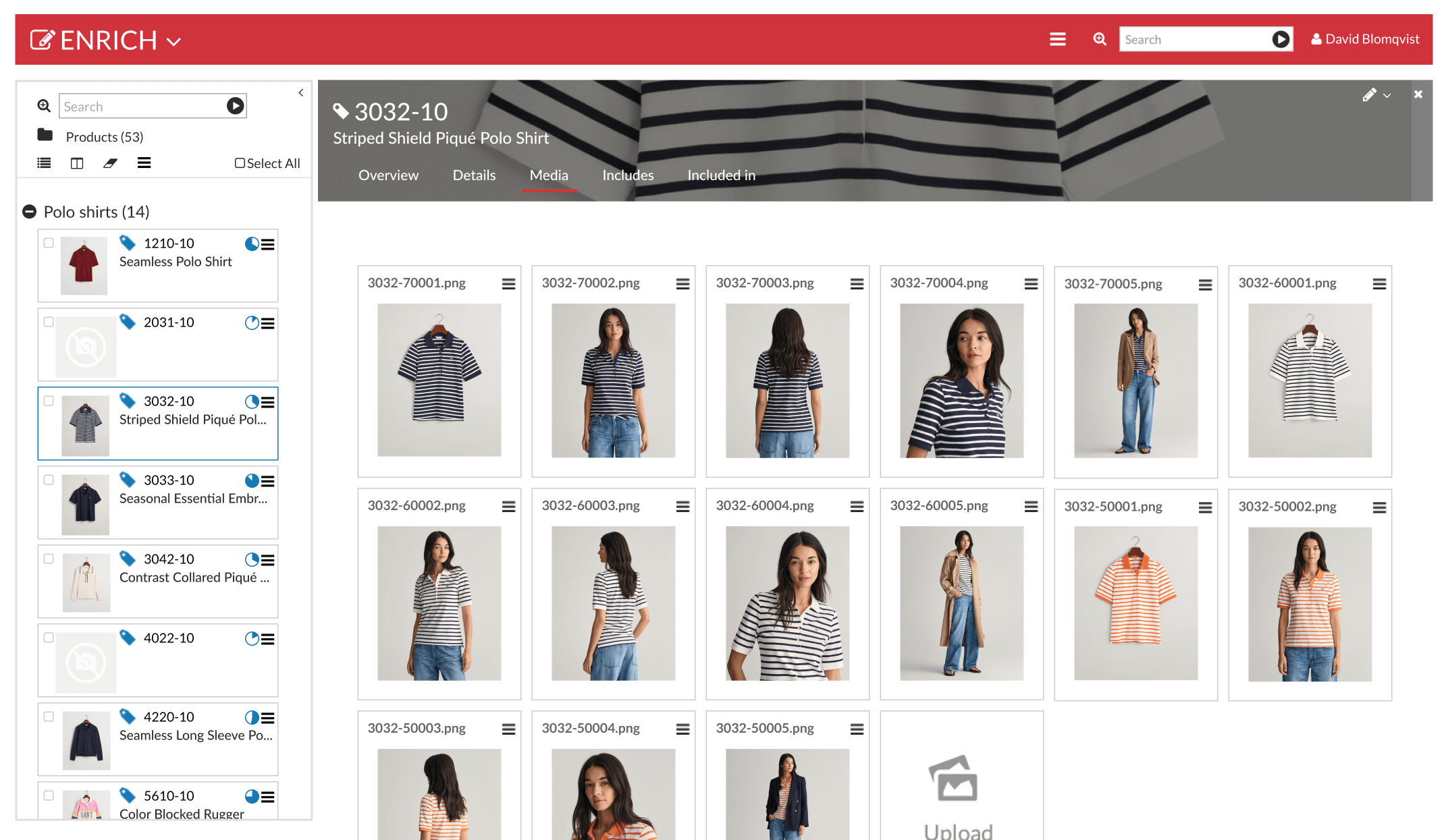
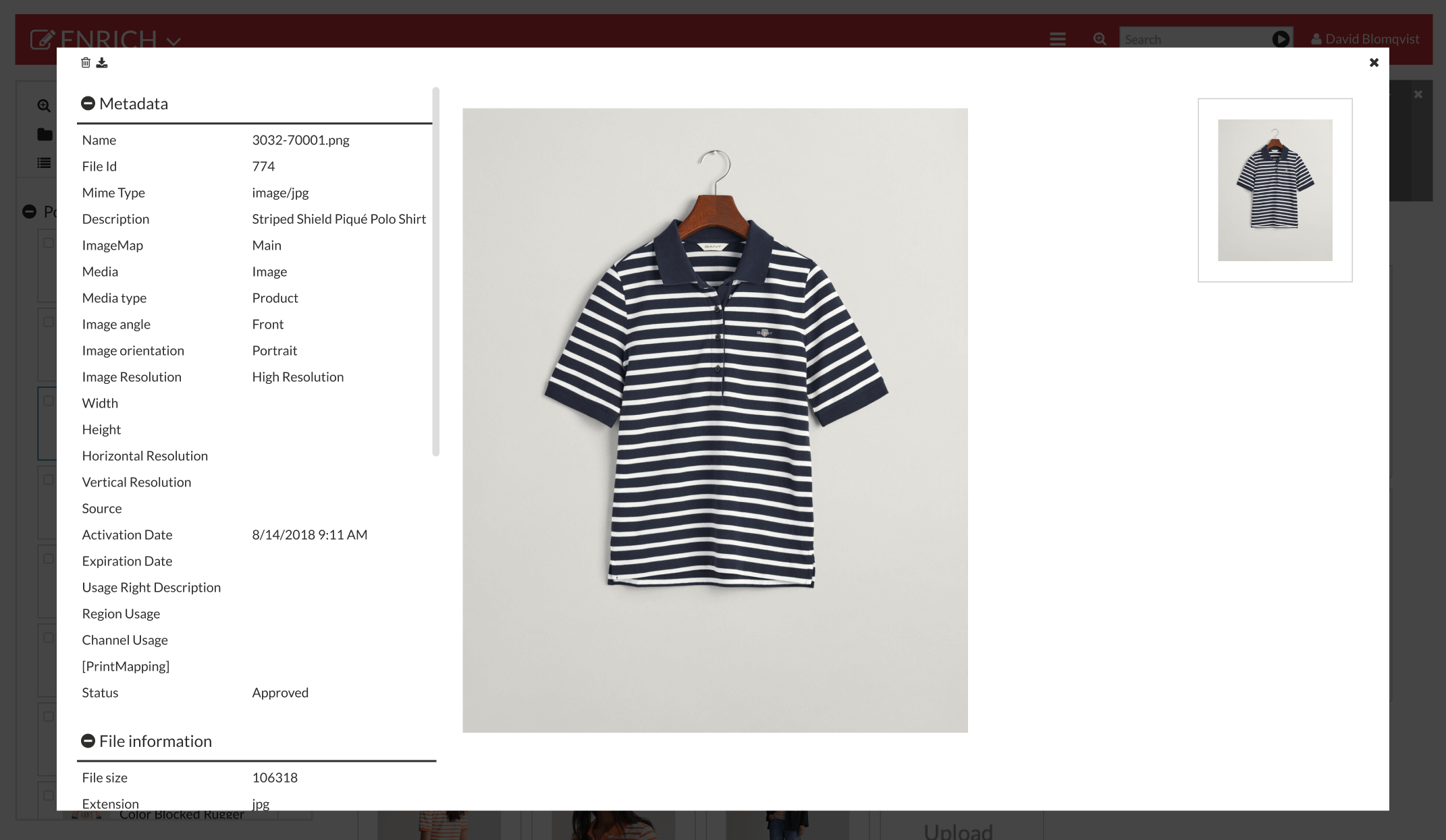
Media page shows all the media files in a card format. Add or delete images. Clicking on a image opens up a detailed page with a bigger image and it's metadata.
Includes and Included in
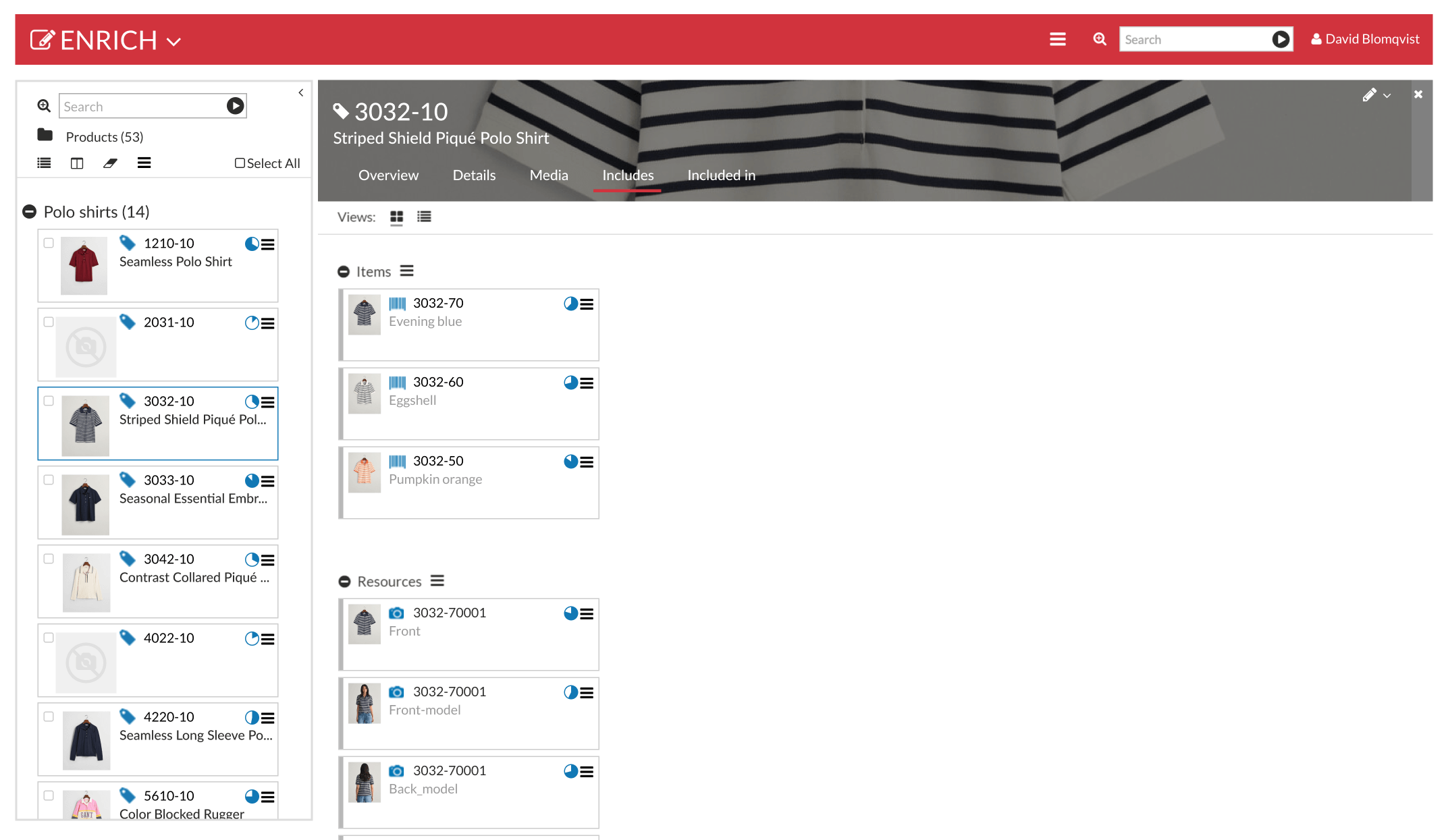
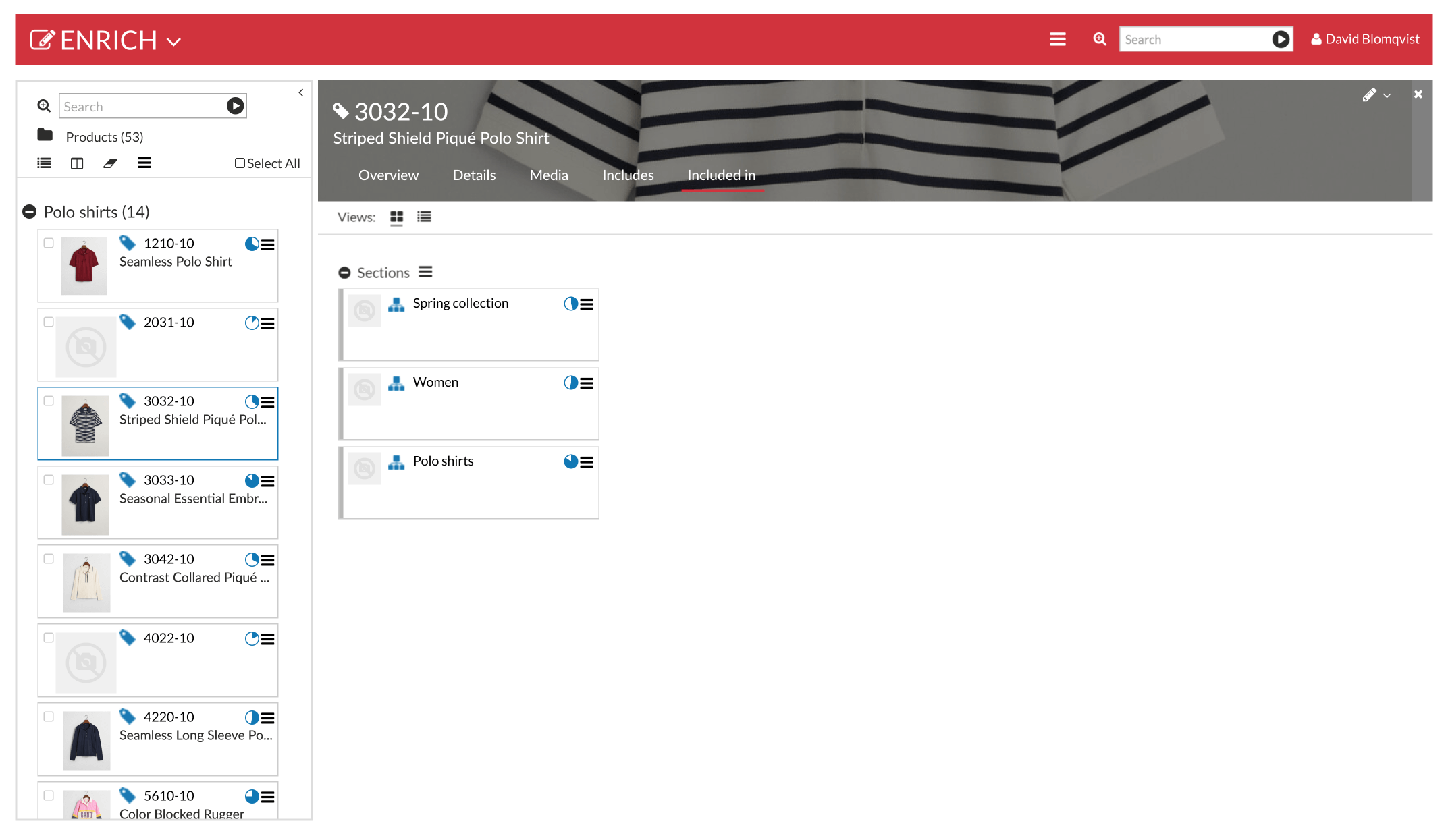
Includes and Included in is Enrich's way of showing a flattened out hierachy. Includes shows what other items the product have under it, and Included in shows what's above it.
Research
So what was going on exactly? After having taking the internal course for the software aiming at giving its empolyees a foundation, I was still scraching my head — It was so complex! New customers are not left on their own, they get an in depth course over weeks. I had the basics, but in no way had I the picture of actually using it as one of Inrivers customers. It was a complex set of niche applications with it's own lingo not used outside the ecommerce ecosystem. This was going to take some time to figure out.
I could already spot several issues, but I needed to hear the voices of our customers first before I got too attached to my own ideas. Before I did that however I talked to the sales team, customer support and dev management teams. This is usually a good starting point in my experience, not only to have their view on things but also to establish a regular presence for design discussions and slowly getting the different teams used to be involved more in the process. This is usually very welcomed at companies not used to have cross collaborating teams. Often there is an underlying desire for more collaboration but for whatever reason, no long term sustainable process is really worked out to improve the situation. Inriver was no exception in this regard.
There were neither any real tracking of customers satisfaction of the service at the time i arrived. There were no NPS score to get hold of — although this was in the works. A few months later this score would turn out to be a positive 3.
After having been briefed on the internally known pain points, it was time to start investigate among the customers. Getting hold of users can be tricky and I initially only managed to get hold of six customers that were eager to help out and also had a varying experience from beginners to experienced with Inrivers PIM system.
I then presented this data to the team and when put into a desireability/feasibility table, this is what came out. The list was long so i try and keep it short to the most interesting items here (highest score is 6 in each)
A brief explanation of each item follows after the table.
| Items | Desirability |
|---|---|
| No feedback in the system | 10 |
| PIM goes offline | 6 |
| Monitor product data quality at marketplaces | 5 |
| Syndication | 4 |
| Excel export monitoring | 3 |
| Includes/Included in alternative | 4 |
| See product image while in Details | 6 |
| Sometimes difficult to follow the rows in Details | 3 |
| System can be very slow | 3 |
| Bigger product images on Overview page | 3 |
| Better overview of product completeness | 5 |
| Too many clicks to get something done | 4 |
| Dashboard is not showing relevant data | 2 |
| Uneccessary clicks when viewing media | 2 |
Export monitoring
A popular function in Enrich was to export products to an Excel sheet. This could be problematic if you tried to export 10 000 products at the same time. This could take hours, and sometimes actually days to export! Problem was you couln't see the progress of the export, so this was a very sought after feature.
Bigger product images on Overview page
The pictures on the overview can be difficult to view since they are so small.
See product image while in Details
Something customers mentioned several times was that it would be great if you could view a large picture on the details page. Often when adding information they also would need to see the pictures at the same time to write a correct description of a product.
Includes/Included in too confusing
Includes/Included in also deemed to be a hot topic amongst the users. While flattening out the hierachy had some benefits, it was also quite confusing since you couldn't see exactly what belonged to what in the hierachy.
This would be the equvalent of Includes, Included in taken from the Details page mentioned earlier above in a more traditional representation of a hierarchy, even if I have somewhat simplified it for this example.
Monitor product data quality at marketplaces
Marketplaces like Amazon and others rate products much like Google rate websites. If the data is complete according to Amazons own requrements, it will be rewarded with a higher visibillity on the site. The PIM is used to collect the right product information, but when the information is uploaded to Amazon for example, there is no way of actually check in realtime if the product is complying to Amazon standards, or how much. This is something several customers asked a solution for.
PIM goes offline
One of the most critical problems. Since Inriver PIM is run in the browser it is critical that the service is stable, particurlarly since this is a software used professionally by businesses relying on it to work. If not, customers will leave and find another PIM provider — so this is a critical to fix.
System can be very slow
Customers report that the responsiveness of the PIM slows down randomly for no apparent reason
The tools in the toolbar are hidden
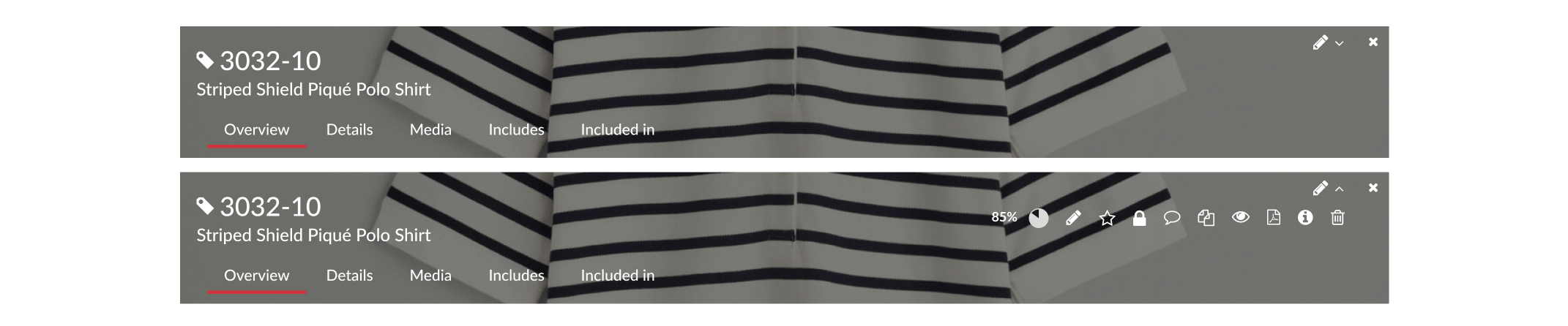
Too access the tools the user first have to click on the toolbar icon. This was regarded as uneccessary and cumbersome since the tools were used frequently and many felt it was annoying to constantly have to click on the icon to open the tools.
Uneccessary clicks when viewing media
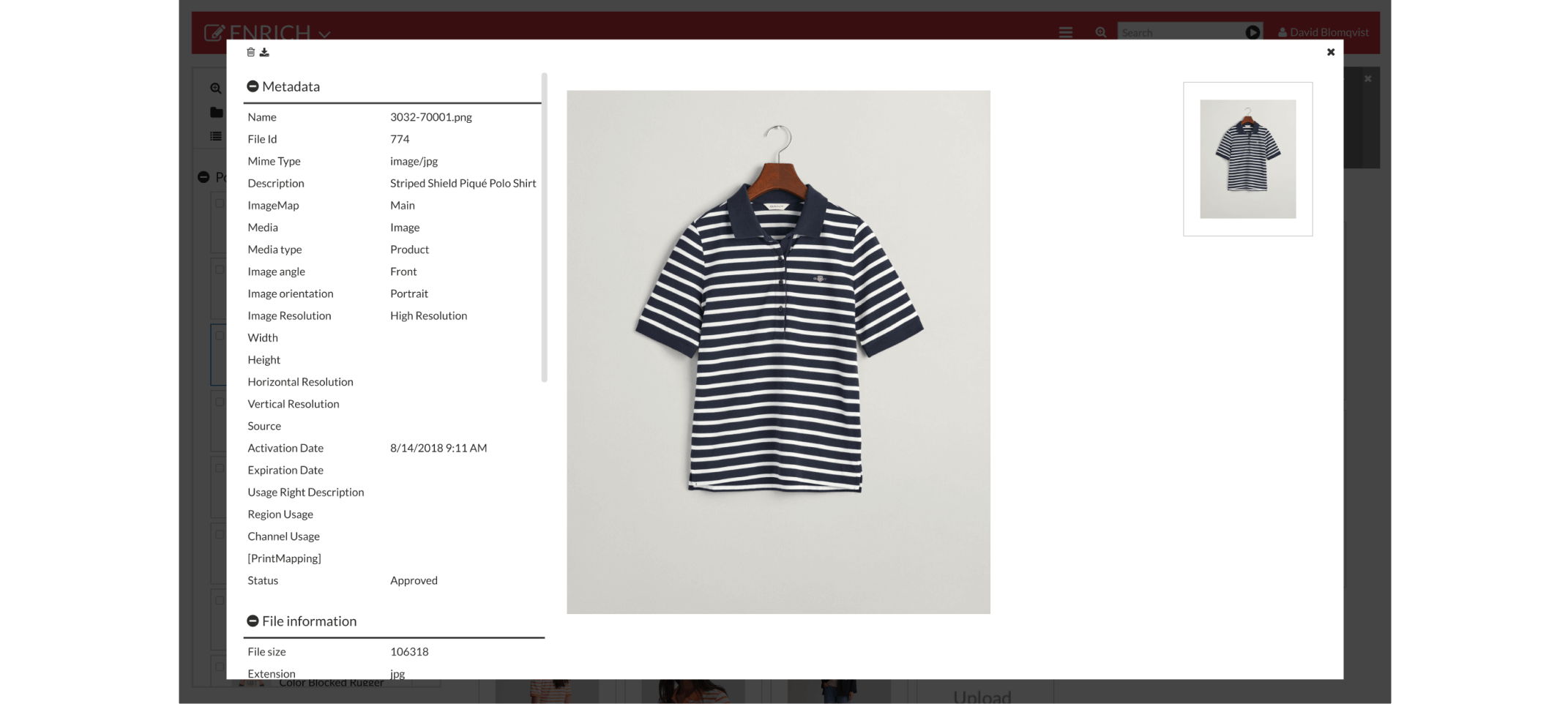
When a user have a media file open on the media page on a modal, there is no way of viewing another image without first closing the modal window.
Big issues, small dev team
A few things stood clear after summing up this information. By far, the issue with the PIM going offline was something most of the customers mentioned imediately — almost before I even could say a word when calling them up. It was clear this was their biggest pain point and something they had asked Inriver to fix for quite awhile. Unfortunately for us, our development team was tiny, just eight people, me included, juggling with six different complex applications at the same time – so these were no easy or fast fixes. This often surprised customers when i mentioned this – they couldn't believe the team was so tiny! Even though Inriver had migrated to the new Saas model recently, old technologies had followed with it to save time, and with it followed the bottle necks.
Inriver had not only a huge design debt, but also a big technical debt. It didn't come as a complete surprise since the several meetings and chats by the coffe machine with the Dev and Customer service teams had surfaced these issues before, but it always hit differently when you hear it directly from the source — especially when the customers a quite concerned.
Eventually the whole thing needed to be rewritten, build it from the ground up with modern technologies and a sound user experience combined. This however would be a very time consuming task considering the advanced level of the software, several years at least probably. So how to get around this in the shorter term?
UI inconsistencies
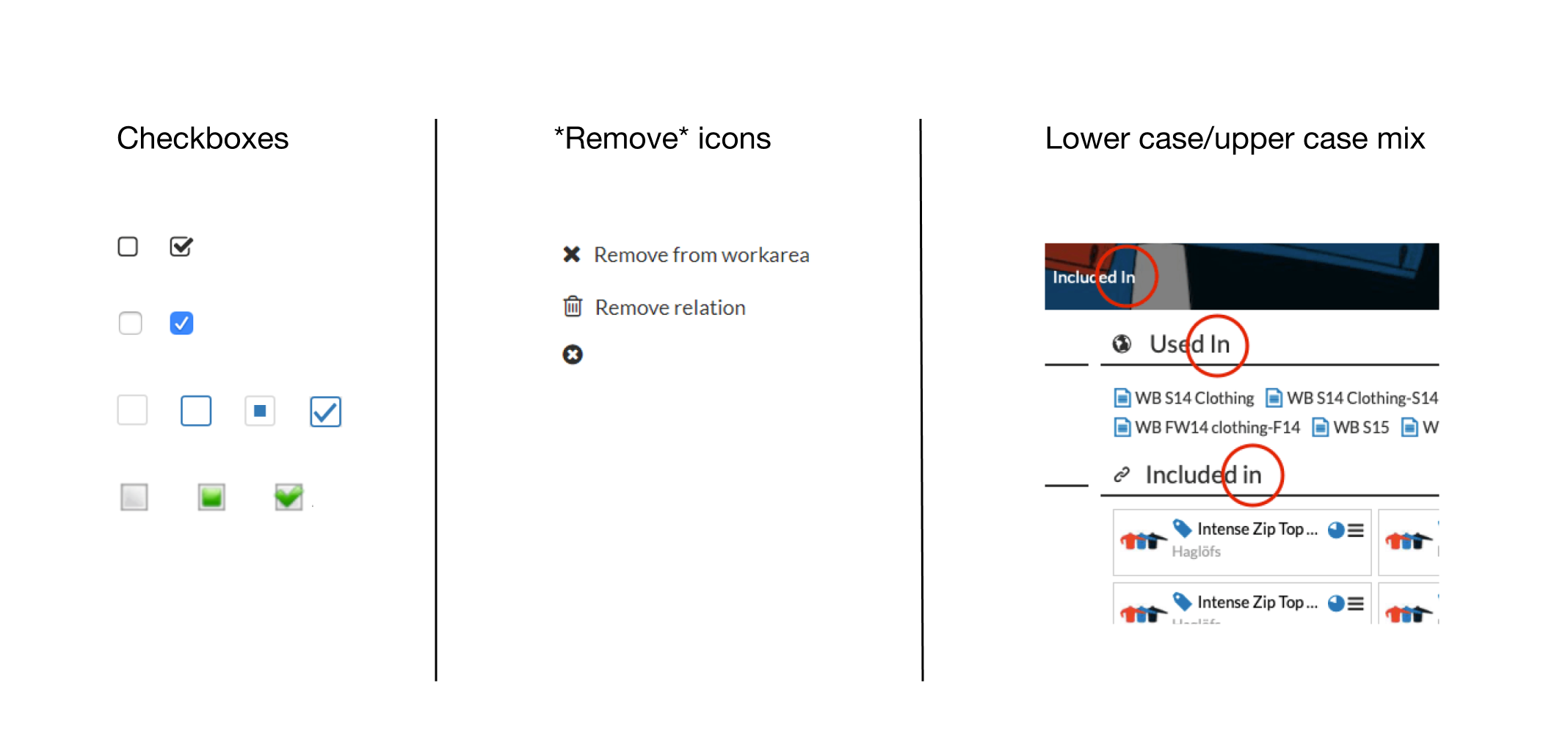
While I had been playing around I also found various inconsistencies in the UI. There were for example at least four different types of checkboxes used, different icons for the same action, and mixed use of lower and upper case in the typography, just to name a few. Quite typical findings when you have different teams working on different parts of the software with no design system in place.
Some tricky choices — and a list of priorities
After some (lengthy) considerations I floated the idea of solving this in two tracks done simultaneusly. One would be to fix the technical bottle necks in backend. These were really critical UX issues and needed top priority. both because of the current issues but also to build the foundation for the next generation PIM system.
The other track would be to fix the current UX issues I personally could do something about that also touched the UI, like export monitoring, image on the Details page etc, and the new syndication app we needed to get out on the market. to offset some of the time this was going to take to accomplish with a re-design of the current software, starting with Enrich to adress some of the other UI related issues that would still be helpful. In this way we could still provide an enhanced experience to our customers and let them know things are changing for the better while we are working on bigger things behind the scene. With some discussions back and forth most of the team liked this plan and we eventually got the boards blessing to go ahead.
We eventually came up with a workable list of projects in priority. I will exclude the critical backend performance projects from this list and focus mostly on the tasks I am directly involved in.
Short term projects
- Export monitoring
- Syndication
Short to mid term projects
- Re-design of Enrich
- Digital shelf analytics
Longer term projects
- The future PIM system